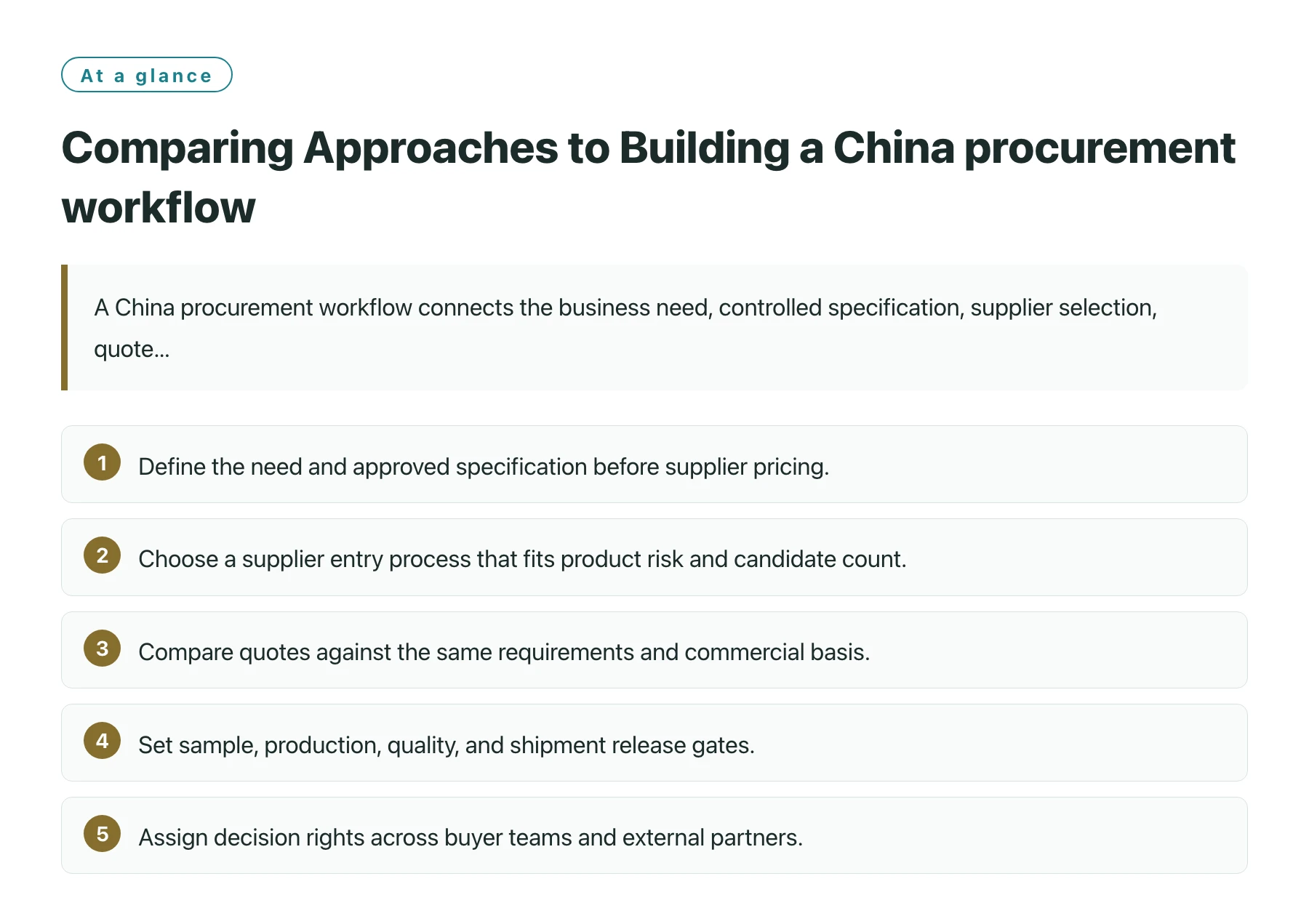
A China procurement workflow connects the business need, controlled specification, supplier selection, quote evaluation, order release, production, and shipment records. Buyers can choose direct, competitive, staged, centralized, distributed, or partner-supported approaches, provided each task has a named owner and approval gate.
Key takeaways
- Define the need and approved specification before supplier pricing.
- Choose a supplier entry process that fits product risk and candidate count.
- Compare quotes against the same requirements and commercial basis.
- Set sample, production, quality, and shipment release gates.
- Assign decision rights across buyer teams and external partners.
A workflow is useful when it prevents conflicting requests and untracked approvals. Its steps should reflect the product and team rather than adding process without a decision purpose.
Map the workflow from need to supplier decision
A China procurement workflow should begin with a defined business need: product, quantity, intended use, destination, schedule, and budget owner. Assign a request owner and a technical reviewer. If the request is incomplete, return open questions before asking suppliers to price different interpretations.
Create a specification and document register with revision, owner, approval status, and date. Include drawings, materials, packaging, labels, tests, and destination requirements where relevant. Mark assumptions and approved equivalents so a vendor cannot silently resolve ambiguity in a way that changes product or cost.
Procurement can include need definition, market analysis, sourcing, negotiation, contracting, and supplier relationship management. CIPS describes these connected activities as part of the procurement cycle.[1] Decide which team owns each stage and where a sourcing partner, supplier, broker, or inspector contributes evidence.
Choose how suppliers enter the process
One workflow is a direct request for quotation to a prequalified supplier. It suits repeat products with a current specification and known commercial terms. The buyer should still reconfirm capacity, price, lead time, configuration, and any changes since the last order.
A competitive sourcing workflow gathers offers from several candidates against the same brief. It can help compare capability and alternatives, but requires consistent instructions, response dates, clarification handling, and evaluation criteria. Decide in advance how technical fit, evidence, schedule, service, and price will be weighed.
A staged process can screen supplier capability before requesting a detailed quote. This may reduce effort when many candidates are available or technical evidence is needed first. Define pass criteria and keep a record of why a supplier advances or is excluded. Avoid asking for sensitive proprietary details before confidentiality and file handling are agreed.
Control quotation review and negotiation
Use a comparison matrix with requirement, supplier response, evidence, deviation, cost, timing, and open owner. Separate confirmed facts from unverified statements. Ask suppliers to identify exclusions, minimum quantities, tooling, sample fees, packaging, payment terms, warranty, and shipping assumptions.
Route technical questions to the engineering or product owner and commercial questions to procurement or finance. Keep clarifications in a shared log, send material answers consistently to all relevant bidders, and update the specification when an answer changes the requested configuration.
Negotiate against the same scope. Record price basis, currency, validity, Incoterm version and named place where applicable, delivery schedule, payment milestones, and treatment of changes. Do not let an email promise conflict with the final purchase order or signed agreement.
Set release gates for sample, production, and shipment
Before order award, close critical deviations and approve the supplier, quote, specification, and sample plan. State who can authorize a substitute or commercial change. If a sample is required, identify type, model, revision, tests, review criteria, and approval owner.
During production, monitor milestones that affect material readiness, inspection, packing, or booking. Set notification thresholds and require a revised plan when a supplier misses a date. Define how quality findings are contained, how corrective action is evaluated, and what must be completed before shipment release.
At dispatch, reconcile actual quantity, carton marks, packing list, invoice, transport instructions, and required destination documents. Assign the importer, broker, supplier, and freight forwarder their document responsibilities. Keep open issues visible instead of marking the workflow complete when goods merely leave the factory.
Compare centralized, distributed, and partner-supported workflows
A centralized workflow uses one buyer team to control templates, approvals, and records across products. It improves consistency when the organization has clear ownership and enough capacity. A distributed model gives product or regional teams more control, which can speed decisions but needs shared revision and supplier controls to avoid conflicting instructions.
A partner-supported workflow can provide supplier research, local coordination, translation, sample tracking, or inspection logistics. Define whether the partner only gathers information or may negotiate and make commitments. Disclose fees and relationships, state how records are shared, and preserve buyer approval over technical acceptance and final order release.
For JS Sourcing, buyers can ask for a workflow proposal that maps each sourcing task to a named output, timeline, fee, and approval gate. Select the support model that fits internal capacity and product risk, then review outcomes after each order to improve handoffs and reduce repeated gaps.
Sources
Frequently asked questions
Should every purchase use a competitive tender?
No. A repeat order with an approved supplier may use a simpler route, while a new or complex requirement may benefit from a staged or competitive process.
Who should own the technical specification?
Name a qualified product or engineering owner, with procurement coordinating revisions and ensuring every supplier prices the same approved version.
Can an external sourcing partner approve an order?
Only if authority is explicitly assigned in the agreement. Buyers should document who can approve technical acceptance, commercial commitments, and final shipment release.
When is a procurement workflow complete?
Close it after delivery and receipt records are reconciled, open issues are assigned, and the buyer has reviewed supplier and process performance.