How to Vet a Private Label Skincare Manufacturer in China: Five Steps
A supplier shortlist is only as good as the evidence behind it. Public pages can tell you a factory runs 35+ production lines and 300+ workers, but they cannot tell you whether your 5,000-unit first run will be scheduled this quarter. The five steps below are the order that keeps a screening decision cheap: route, order stage, three cost numbers, risk, then a three-supplier hold.

Key takeaways
- Decide the formula route before you shortlist: an existing base from a 10,000+ formula library and a bespoke development are two different projects.
- Match the supplier to your order stage. Published order minimums in this sector usually sit at 1,000–5,000 units, with 500-unit entry points for start-ups.
- Three numbers decide the real cost: minimum order quantity, the stability window (commonly 3–6 months) and packaging lead time.
- Hold three suppliers until one sample is approved in writing; a single-source shortlist removes your only negotiating lever.
Step one: fix the formula route first
Start with the question the quotation cannot answer later: does this product need a new formula, or a proven one in your packaging? A private label launch built on an existing base moves through sampling in weeks. A new formula adds laboratory iterations, compatibility work and stability time, and those weeks are the ones buyers underestimate.
Ask for the route in writing as "existing formula, adjusted" or "new development". The two routes carry different minimums and different schedules, and mixing them in one comparison table is how a shortlist becomes meaningless.
Step two: match the supplier to your order stage
Capacity is not the same as willingness. A plant that runs 35+ lines and ships 160 million units a year can still take a 5,000-unit pilot, but the pilot has to fit a production calendar. Ask what the smallest order they accepted in the last two quarters was, then compare that with your number.
Published order minimums for skincare OEM work usually land between 1,000 and 5,000 units per product, and some factories open a 500-unit door for first orders. If you plan 500 units to test the market, say so in the first email rather than at the sampling stage.
Step three: screen the three numbers that change real cost
Price per unit is the last number to move. The first three are order quantity, testing and packaging. Testing alone can take three to six months for stability and compatibility reports, and that window runs in parallel with packaging tooling, not after it. A supplier who quotes a unit price without naming those two windows is quoting half a project.
| Number | Published value | What it changes |
|---|---|---|
| Order minimum | 1,000–5,000 units per product; 500 units for start-ups | Cash tied up in the first run and the size of the market test |
| Stability and compatibility reports | 3–6 months | Realistic launch date; can run alongside tooling |
| Lead time, existing formula | 4–8 weeks | Sampling to first saleable batch on the faster route |
| Lead time, new development | 3–6 months | Research, testing and production treated as one block |
Step four: check product and market risk before the price
Two candidates can quote the same unit price and carry different risk. For skincare the risk usually sits in the claims: anything about sensitive skin needs patch test results, and anything about anti-ageing needs a formula that survives its own shelf life. Read the intended claims against the evidence the factory says it can supply.
Also check the documents you will actually need at the border: certificate copies matched to the product, stability reports with dates, and a specification sheet that matches the sample you approved. Ask for one example of each before you pay a deposit.
Step five: keep three suppliers until a sample is approved
Samples take weeks, so the strongest position is holding three live quotations while one sample is tested. Two of the three will not survive the first comparison, and that is the point: the moment you reduce to one supplier, the schedule and the terms stop being negotiable.
Give every candidate the same brief, the same pack size and the same target launch window, then score them on the same five criteria. A short scorecard gets you a decision in days instead of a second round of emails.
Worked example: what a 5,000-unit pilot costs in line time
Take a factory that publishes 160 million skincare products a year across 35+ production lines. Spread over a 365-day year that is 160,000,000 ÷ 365 = 438,356 units a day for the plant as a whole. Divide by the 35 lines and one line accounts for 438,356 ÷ 35 = 12,524 units a day. Divide the plant figure by the 300+ workers instead and each worker stands behind 438,356 ÷ 300 = 1,461 units a day. The arithmetic is mine; the three inputs are the published figures.
A 5,000-unit pilot therefore represents 5,000 ÷ 12,524 = 0.4 of one line's day, roughly three hours of output. That is the number to put in the first email. It tells the factory immediately that you are asking for a small slot rather than a share of a season, and it explains why a 500-unit start-up order has to be quoted around other runs.
What the capacity arithmetic shows
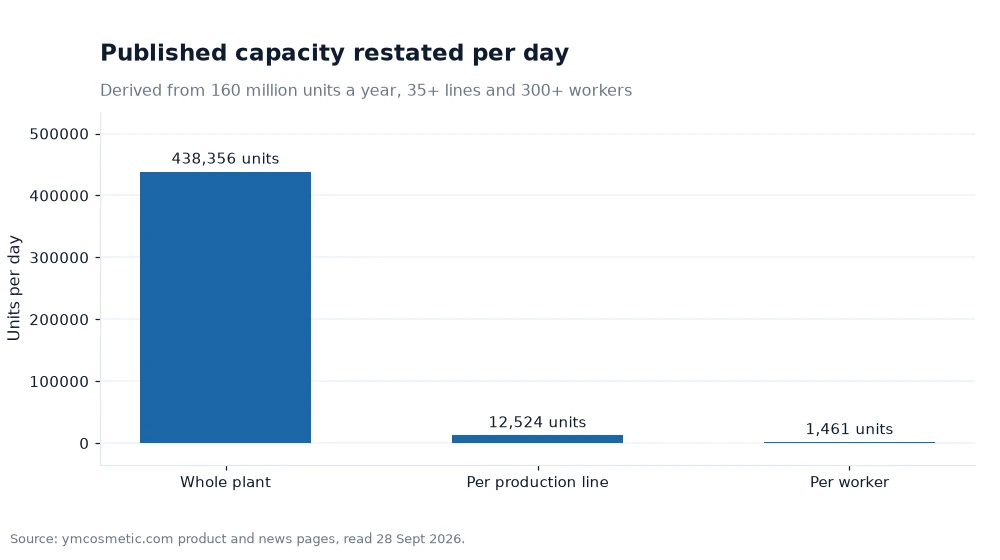
Read the first two bars together and the pilot question answers itself. Against a plant figure of 438,356 units a day, a 5,000-unit pilot is 1.1% of one day's output; against a single line it is 40% of a shift. The same order looks large or small depending on which number you quote, which is why the brief should state both the quantity and the line time you are asking for.
Frequently asked questions
How many suppliers should stay on a shortlist at the sampling stage?
Three is a workable number. Two rarely survive the first sample comparison, and one leaves you without a fallback if the sample misses the brief. Keep all three on the same written brief and the same pack size so the samples stay comparable.
Is a 500-unit first order realistic for a new skincare brand?
Yes. Some factories publish a 500-unit entry point for start-ups, while the general band for skincare OEM work sits at 1,000–5,000 units per product. Expect the smaller order to be scheduled around larger runs and to carry a higher unit cost.
What should be in the first email to a supplier?
Product type, pack size, target quantity, the formula route you want and your launch window. Add the claim you intend to make, because claims decide which test reports you need and how long the preparation takes.
Using the five steps in practice
Run the screen in order and the shortlist shrinks fast: route, order stage, the three cost numbers, risk, then samples. If you want a worked comparison of the suppliers themselves, the published list of private label skincare manufacturers China buyers shortlist applies the same five filters to ten named companies, and it reads as a buyer's checklist rather than a catalogue. For the manufacturing side of the same decision, Yunmei's page on OEM/ODM cosmetic manufacturing services sets out the routes, the sample process and the factory inspection policy in one place. Pair that with the cleanser range page when your first product is a wash-off formula, because textures and types are specified differently there than on a cream line.
Every figure used above — the order bands, the testing windows and the capacity numbers — was read on 28 Sept 2026 from ymcosmetic.com, the manufacturer's own website. The plant, per-line and per-worker unit counts are my arithmetic on that published annual output, line count and headcount.[1].