Founders usually pick a format the way they pick a note: by preference. The format then decides a chain of costs, delivery limits and regulatory details that were never part of the preference. A solid stick and a roll-on oil can carry the same scent and behave completely differently on a shelf, in a warehouse, in a handbag and in a summer delivery van. The practical approach is to price four trade-offs before choosing: fragrance cost per unit, delivery behaviour, climate risk, and packaging. Once those are on one page, the format decision usually makes itself.
Key takeaways
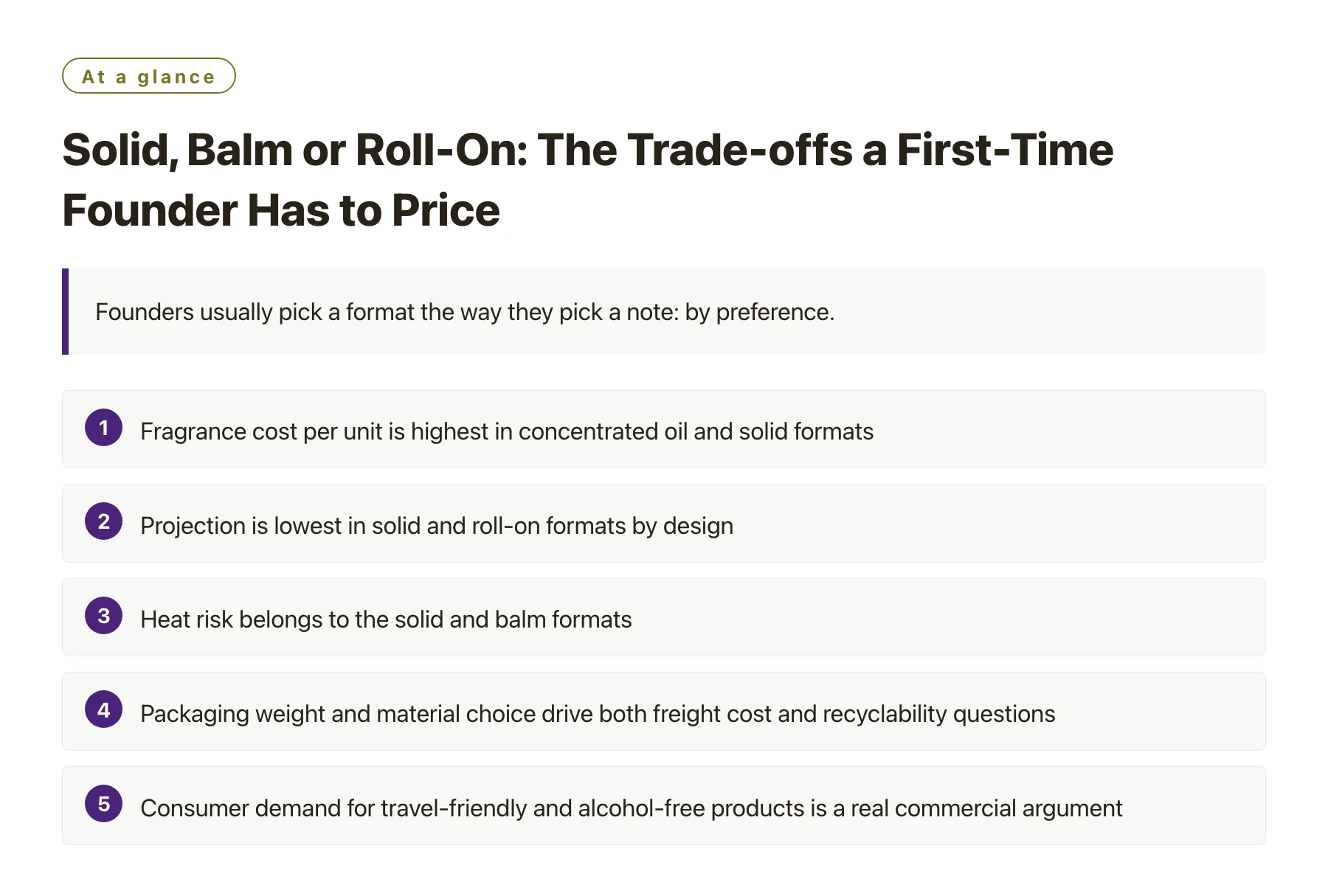
- Fragrance cost per unit is highest in concentrated oil and solid formats, because there is no solvent diluting the concentrate across a large fill volume.
- Projection is lowest in solid and roll-on formats by design, so a brand whose positioning depends on a strong trail should not choose them for price reasons alone.
- Heat risk belongs to the solid and balm formats, while leak risk belongs to the liquid ones, and each requires a different packaging and testing response.
- Packaging weight and material choice drive both freight cost and recyclability questions, and the rules on packaging waste are tightening rather than loosening [2].
- Consumer demand for travel-friendly and alcohol-free products is a real commercial argument, but it should be supported by your own market evidence rather than assumed [1].
As a first-time founder I had a fixed budget for my first order and three formats in front of me. The per-unit figures looked close, which is exactly why the decision was hard: the differences were not in the unit price, they were in what the unit price contained.
A solid uses a large mass of base and a comparatively small mass of concentrate. An oil uses a small mass of product with a high concentrate share. A spray uses the most product and the least concentrate per millilitre. Those three ratios explain most of the cost, weight and performance differences that follow.
This is the sheet I wish I had built before ordering, with the four trade-offs priced honestly and the formats compared on the columns that actually decide the outcome.
Four trade-offs, three formats, one comparison
| Trade-off | Spray | Solid stick or balm | Roll-on oil |
|---|---|---|---|
| Fragrance cost per unit | Lowest share of the unit price, because the fill volume is mostly solvent. | Moderate; the base is inexpensive relative to concentrate but the load is high. | Highest share, because a small fill still carries a high concentrate percentage. |
| Projection and trail | Strongest; the alcohol carries the scent outward. | Weakest; scent stays close to the skin and unfolds slowly. | Moderate to weak; intense at the application point, quiet beyond it. |
| Climate and transit risk | Leak and evaporation risk at the closure; alcohol classification for transport. | Softening, sweating and surface damage in heat; needs tested packing. | Leak risk through the ball housing; carrier can cloud in cold. |
| Packaging weight and material | Glass bottle, pump or cap, often the heaviest option. | Light tube or tin; often the lightest and the easiest to post. | Small glass or plastic vial with a ball housing and closure. |
| Perceived value at the shelf | Familiar and easy to read; usually the reference point customers compare against. | Reads as considered and travel-friendly; small unit can look like poor value. | Reads as intense and premium; the small size needs explaining. |
| Typical fit | Brands whose positioning depends on presence and trail. | Travel, gift, refill-adjacent and alcohol-free positioning. | Sensitive-skin, roll-on convenience and concentrated formats. |
None of these columns is a verdict. They are the numbers and behaviours to price before choosing, and a brand can reasonably decide that a weaker trail is a fair price for a lighter, alcohol-free unit.
Trade-off one: the concentrate is the expensive part
Fragrance concentrate is usually the most expensive ingredient per gram in any of these products. A spray spreads a small amount of concentrate across a large fill, which makes the unit look cheap. A roll-on delivers a small fill with a high concentrate share, so the concentrate dominates the cost. A solid sits between the two, with a cheap base carrying a high load.
This has a counterintuitive consequence. Raising the fill weight of a solid makes the unit larger and heavier without adding much cost, while raising the fill weight of an oil adds cost quickly. If a brand wants to sell a substantial-feeling product at a modest price, the solid format is often the easier arithmetic.
The reverse is also true. If the brief calls for a very high fragrance load, the oil format exposes that cost most visibly, and the solid format may fail structurally before it reaches the target.
Trade-off two: quiet scents are a feature, not a defect
Solid and oil formats do not project the way a spray does, and no amount of perfumery changes that entirely, because there is no volatile carrier to lift the scent into the air. What they offer instead is a scent that stays close and lasts, which some customers actively prefer.
The commercial risk is positioning rather than performance. A brand that markets on presence, trail and compliments will disappoint customers who buy these formats expecting them. A brand that markets on intimacy, discretion, travel or sensitive skin is selling exactly what the format does well.
Decide which story you are telling before choosing the format, because changing that story after launch is more expensive than changing the format before it.
Trade-off three: climate decides more than you expect
A solid that performs well in a temperate market can fail in a hot one, and the failure appears in storage rather than on the skin. Softening, sweating and cosmetic damage in transit are the recurring complaints, and they are manageable with a firmer base, tested packing and, in some cases, a smaller unit that heats through less.
The roll-on has the opposite problem profile. Cold can cloud a carrier, and the ball housing is a leak point under pressure changes. Both are testable, and both should be tested with the finished unit in its final packaging rather than with a bare sample.
The point of pricing this trade-off is to know what the mitigation costs before the first order. A firmer base may raise the load ceiling; better packing adds freight; a different closure adds unit cost. Those are decisions, not surprises, if they are on the sheet.
Trade-off four: packaging carries the compliance conversation
Packaging choice determines weight, cost and how the product is perceived, and it also determines which material rules apply. In the European Union, packaging waste rules are being revised with more emphasis on recyclability and on the material a package is made of, and the practical effect is that a plastic-heavy format needs a clearer sustainability answer than it did a few years ago [2].
This does not mean avoiding plastic. It means knowing what your chosen format will have to explain. A refillable or post-consumer-content option may cost more per unit and less per customer over time, and a tin or tube may be easier to defend than a multi-material assembly.
Founders often leave this until artwork, which is too late. Packaging material and format are decided together, and changing one after the other is fixed usually means a new structural sample.
Build the comparison sheet with real quotes for the same scent, the same fill weight and the same market. A format comparison based on different briefs is not a comparison, it is three unrelated projects.
What the choice looks like once it is priced
After the four trade-offs are on one page, the decision is usually less about the format and more about the story, the price point and the market. A brand selling into hot climates with a low price point tends to land on solid. A brand selling on intensity and skin feel tends to land on oil. A brand whose customer expects presence tends to stay with a spray and use a solid or oil as a line extension.
It also helps to work with a manufacturer comfortable across several formats, because the comparison can then be run on the same concentrate rather than across three different development projects. A partner with experience as a perfume OEM/ODM manufacturer will normally be able to quote more than one format against the same brief, which is the fastest way to get comparable numbers.
One further cost is worth counting, even though it never appears on a quote: the founder's own time. Learning to evaluate formats takes a specific kind of practice, and a founder who has taken some professional scent training usually gets to a decision with fewer sample rounds and less second-guessing.
Finally, if the plan is to sell at a premium, the manufacturing base matters more than the label. A manufacturer used to fine fragrance manufacturing will apply a different standard to raw materials, stability and consistency than one set up for volume commodity work, and that standard is often what the price premium is actually paying for.
It is worth asking whether a supplier treats all three formats as equal. A house such as XUELEI that works across fine fragrance, home fragrance and scented body products will normally give a straight answer about which formats it runs best, and that answer is more useful than a quote for every option on the sheet.
Sources
- Mintel Press Centre —— Mintel's press releases on consumer and beauty market research, including fragrance and personal care trend reporting.
- European Commission: Packaging Waste and the PPWR —— EU rules on packaging and packaging waste, including the Packaging and Packaging Waste Regulation requirements on recyclability and design.
Frequently asked questions
Which format is cheapest for a first order?
There is no universal answer, because the cheapest unit is not the cheapest project. Solids often win on unit cost for a substantial-feeling product, oils carry the highest concentrate share and sprays the largest fill volume. Compare the same brief across formats before drawing a conclusion.
Can I launch a solid and a roll-on version of the same scent?
Yes, and it is a common way to cover two use occasions. Expect to adjust the formula for each base, and budget an additional sampling round per format rather than assuming the concentrate transfers unchanged.
Do alcohol-free formats sell better in some markets?
Consumer research on fragrance and beauty preferences is widely published, and formats positioned as travel-friendly or alcohol-free have grown in several categories. That is a general market signal rather than a forecast for a specific product, so test it against your own audience before building a range around it.
How does packaging regulation change the format decision?
It mostly changes the cost of defending the choice. Rules on packaging waste are moving toward higher recyclability expectations, so a format with a simple, single-material package is easier to explain than a multi-material one. Factor that in before the structural design is fixed.
Is a solid format suitable for a premium price point?
It can be, but the premium has to come from the scent, the base quality and the presentation rather than from the format alone, because the unit is small and light. Customers used to spray volumes may read a small solid as a sample rather than a full product.